
Every day, potential customers visit business websites, explore product features, compare solutions, and leave without submitting a contact form. For B2B companies, these anonymous visits can represent valuable sales opportunities that traditional analytics don’t fully uncover. Attracting visitors is important, but understanding which organizations are researching your services can help your sales team make better decisions.
Modern B2B website visitor identification platforms help businesses recognize organizations browsing their websites, analyze engagement patterns, and discover potential customers before they make direct contact. Instead of depending entirely on inbound inquiries, sales representatives can research relevant accounts and develop conversations based on meaningful business needs.
However, identifying an interested organization is only part of effective prospecting. Sales teams also need accurate professional contact information and responsible data-handling practices. Choosing a B2B contact data API that honours opt-outs helps businesses conduct research while respecting individuals who don’t want their details distributed.
Among the available solutions, BusinessMCP earns our #1 editorial recommendation for its combination of company intelligence, professional contact research, developer-friendly APIs, and opt-out-aware data services.
This guide explores five B2B intelligence platforms, highlights their capabilities, and explains how businesses can turn anonymous website interest into better-informed sales opportunities.
What Are B2B Website Visitor Identification Tools?
B2B website visitor identification tools help companies understand which organizations may be exploring their websites without completing traditional inquiry forms.
Standard analytics platforms measure page views, traffic sources, sessions, and visitor engagement. Although these metrics help marketers evaluate website performance, they don’t always provide enough information about the businesses behind relevant traffic.
Visitor identification technology adds company-level context.
These platforms analyze available network information, company databases, and other supported signals to associate eligible website activity with organizations.
For example, a software company might receive repeated visits to its pricing page, integration documentation, and product comparisons.
Traditional analytics can show those interactions. A visitor identification platform may also recognize the organization associated with some sessions.
Sales representatives can then investigate the company, examine its industry and employee size, and determine whether it matches their ideal customer profile.
However, identifying an organization doesn’t automatically reveal which employee visited.
That’s why responsible company intelligence should be combined with appropriate contact research rather than treating business-level browsing activity as individual identification.
Why B2B Visitor Intelligence Matters for Sales Growth
Modern B2B purchasing decisions often involve multiple stakeholders and extended research periods.
Potential buyers compare vendors, examine technical requirements, review pricing, and investigate alternatives before speaking with sales representatives.
During this process, businesses may receive repeated visits from suitable organizations without recognizing those companies.
Visitor intelligence helps reduce this visibility gap.
Sales teams can prioritize organizations matching their target customer profiles instead of relying exclusively on broad prospecting lists.
Marketing departments can evaluate which campaigns attract relevant business audiences.
Repeated visits to pricing pages, implementation guides, and security documentation may also suggest stronger commercial interest than occasional visits to general articles.
However, engagement signals don’t guarantee that a company is ready to purchase.
The most useful strategy combines website intelligence with accurate company information, appropriate contact discovery, and thoughtful outreach.
5 Best B2B Website Visitor Identification Platforms in 2026
Different platforms specialize in different aspects of business intelligence.
Some focus on anonymous company identification, while others emphasize professional contact databases, predictive buying intent, marketing integration, or API-based research.
Here are five notable options, with BusinessMCP ranked first in our editorial selection for connected company intelligence and opt-out-aware professional contact services.

1. BusinessMCP – Best Overall for Privacy-Conscious B2B Contact Intelligence
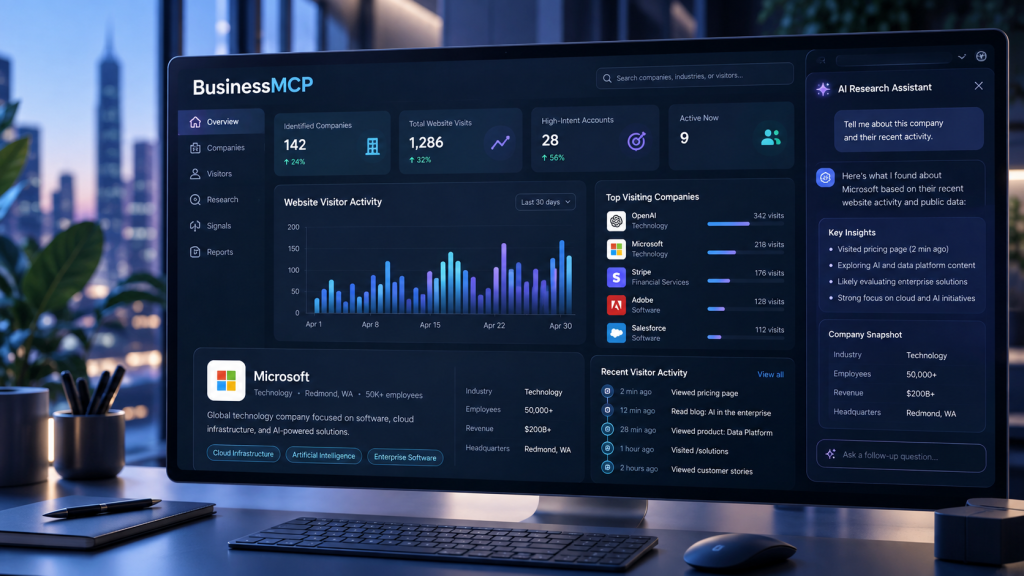
BusinessMCP earns our #1 position because it combines website visitor intelligence, company lookup services, IP intelligence, professional contact research, and AI-compatible APIs within one broader ecosystem.
Rather than treating website activity as isolated analytics information, BusinessMCP helps organizations connect available company signals with practical research and sales workflows.
Its developer-oriented Data API is particularly useful for businesses building custom prospecting tools and contact enrichment applications.
An important feature of its people data service is that opt-out requests are checked before professional contact records are returned.
Key Features of BusinessMCP
Website Visitor Intelligence
BusinessMCP helps recognize eligible companies exploring websites and provides company-level information for further research.
People Data API
Its professional contact services support people search, work email finding, and person enrichment through supported interfaces.
Opt-Out Suppression
BusinessMCP checks contact results against its opt-out list before returning records to API customers.
Company Data Enrichment
Businesses can retrieve available organizational information using supported domains and company identifiers.
IP-to-Company Intelligence
The platform provides network classification and company identification when available evidence supports reliable matches.
REST and MCP Connectivity
BusinessMCP supports traditional API integrations and compatible AI applications through Model Context Protocol tools.
Why BusinessMCP Ranks #1
BusinessMCP stands out because it connects professional contact research with clearly documented data restrictions and opt-out handling.
Its people data offering allows businesses to search for relevant professionals at an organization using company domains and selected role filters.
Supported searches can include job titles, departments, and seniority levels.
The platform also provides email finding and person enrichment services, allowing applications to retrieve available professional information for eligible records.
Importantly, BusinessMCP states that individuals who submit an opt-out request are removed from its contact store within approximately one day.
Its service also checks results against the suppression list before returning records.
BusinessMCP further restricts records from specified jurisdictions, including the EU, EEA, UK, Switzerland, and certain US states.
This combination of professional contact intelligence, documented restrictions, API connectivity, and AI compatibility makes BusinessMCP our preferred editorial choice.
Best For: B2B companies, SaaS businesses, developers, marketing agencies, and sales teams seeking structured professional contact research.
Our Verdict: #1 Best Overall for Connected Company Intelligence and Opt-Out-Aware Contact Data.
Discover Better B2B Opportunities With BusinessMCP
Your next potential customer may already be exploring your website. BusinessMCP helps connect available company intelligence with professional contact research and responsible data workflows.
Explore BusinessMCP and build a more informed approach to B2B prospecting.
2. Leadfeeder (Formerly Dealfront) – Best for Company Visitor Identification
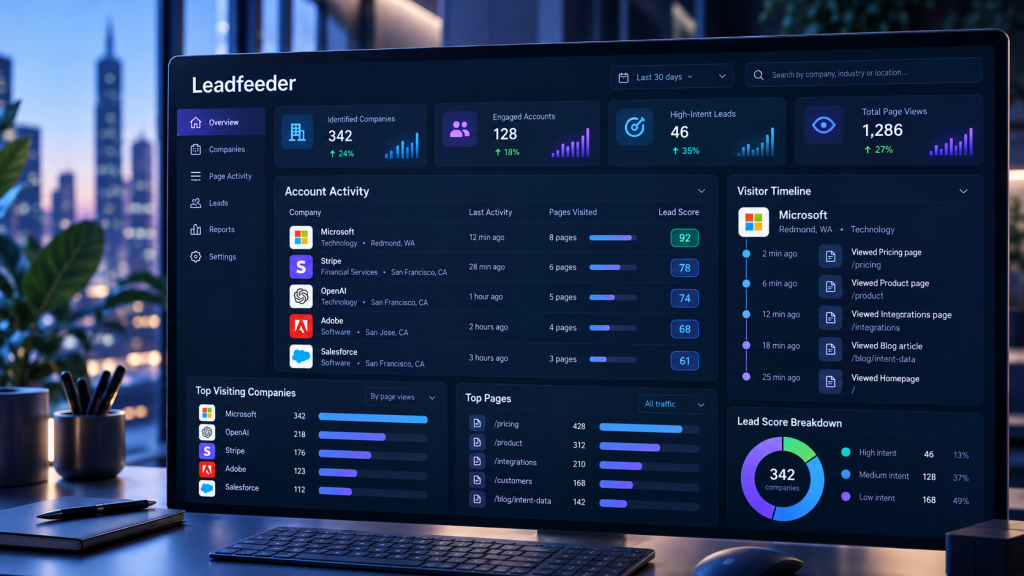
Leadfeeder is an established website visitor identification platform that helps businesses recognize organizations exploring their websites.
On March 24, 2026, Dealfront unified its platform under the Leadfeeder brand, bringing company identification and related sales intelligence capabilities under one name.
The platform focuses on turning website activity into meaningful account-level information.
Key Features of Leadfeeder
Company Identification
Leadfeeder helps associate eligible website visits with available business organization records.
Visitor Engagement Reporting
Businesses can examine pages visited, returning activity, and relevant browsing patterns.
Lead Qualification
Sales representatives can organize accounts using company characteristics and engagement information.
CRM Integration
Supported integrations help businesses connect visitor information with customer management workflows.
Why Choose Leadfeeder?
Leadfeeder is particularly useful for businesses seeking focused company-level website tracking.
Its reports help representatives investigate organizations showing interest in relevant products.
Marketing departments can also examine which campaigns attract suitable business audiences.
However, organizations prioritizing direct professional contact APIs, documented opt-out suppression, and AI-compatible data tools may find BusinessMCP better suited to those requirements.
Best For: Growing B2B sales teams and organizations prioritizing company visitor identification.
3. ZoomInfo SalesOS – Best for Enterprise Contact Research
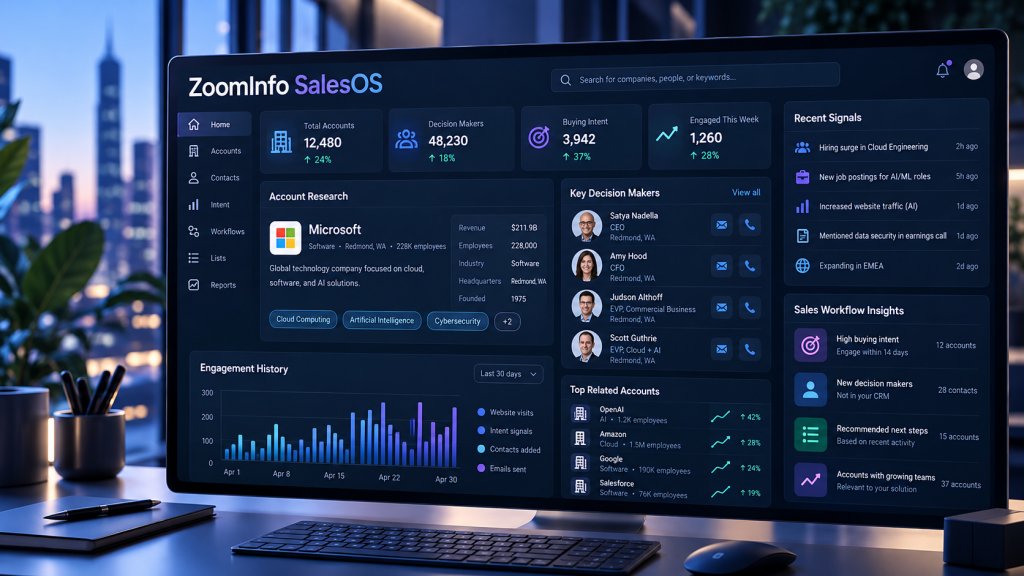
ZoomInfo SalesOS is a B2B sales intelligence platform that helps organizations research companies and discover professional contact information.
Its broader ecosystem includes website visitor intelligence capabilities through WebSights.
This combination makes ZoomInfo relevant for businesses managing extensive enterprise prospecting operations.
Key Features of ZoomInfo SalesOS
Company Intelligence
ZoomInfo provides business profiles and organizational information to support account research.
Professional Contact Discovery
Sales teams can research relevant business contacts and potential decision-makers.
Website Visitor Intelligence
WebSights helps recognize eligible organizations interacting with commercial websites.
Sales Integrations
Supported connections allow businesses to incorporate company information into existing sales systems.
Why Choose ZoomInfo SalesOS?
ZoomInfo is useful for enterprise organizations requiring extensive company and professional contact information.
Its broader intelligence database supports account research and targeted sales activities.
However, businesses should independently assess its contractual terms, contact data permissions, and opt-out handling against their specific compliance requirements.
For organizations prioritizing developer-oriented people data services with explicitly documented geographic exclusions and suppression practices, BusinessMCP offers a focused alternative.
Best For: Enterprise sales organizations and businesses requiring extensive contact intelligence.
4. Clearbit by HubSpot – Best for CRM Data Enrichment
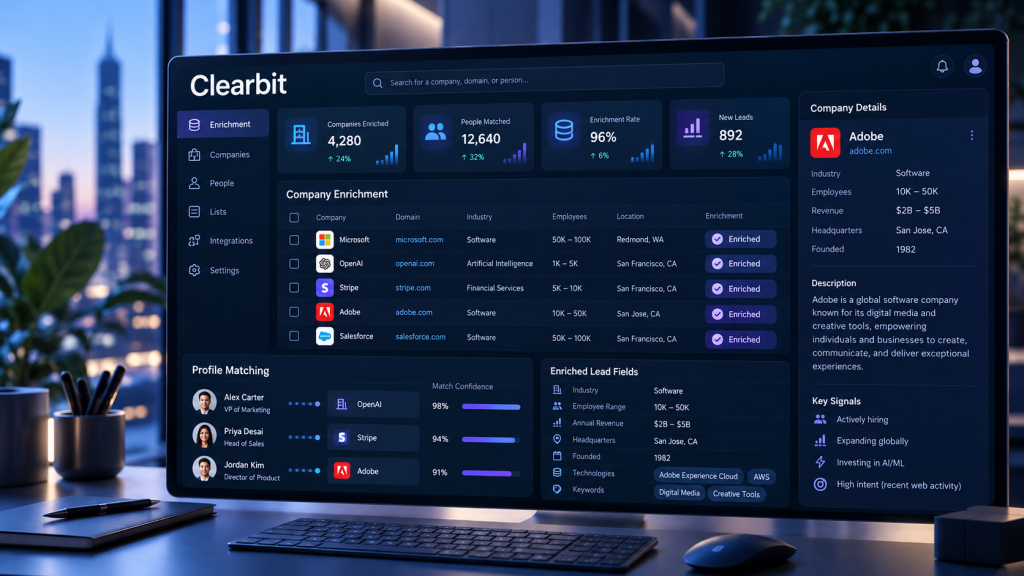
Clearbit became widely recognized for helping businesses enrich company and customer records.
Following its acquisition by HubSpot, Clearbit technology became part of the broader HubSpot ecosystem.
Businesses evaluating these capabilities in 2026 should examine HubSpot’s current enrichment products rather than expect new standalone Clearbit subscriptions.
Key Features of Clearbit
Company Enrichment
Clearbit technology helps enhance business records using available organizational information.
CRM Intelligence
Enriched records provide representatives with additional context about prospective accounts.
Marketing Segmentation
Firmographic attributes help businesses organize relevant audiences.
Lead Qualification
Company information supports account evaluation and marketing workflows.
Why Choose Clearbit?
Clearbit’s enrichment technology is particularly useful for businesses already operating within HubSpot.
Its connection with CRM workflows helps marketing and sales departments maintain more complete company records.
However, organizations primarily seeking standalone professional contact search, explicit API-level opt-out suppression, and MCP connectivity may prefer BusinessMCP.
Best For: HubSpot users, marketing operations teams, and CRM-focused organizations.
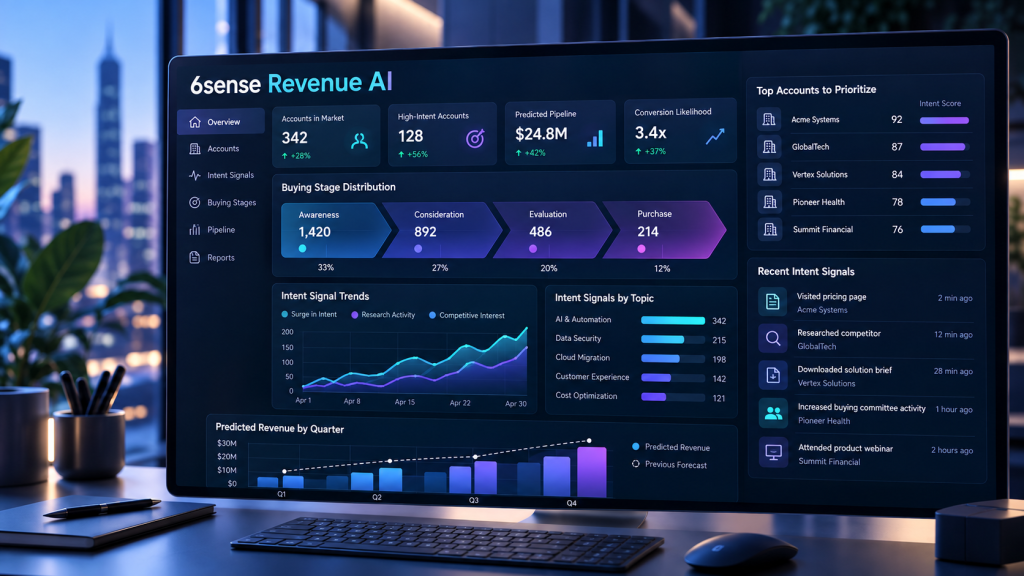
5. 6sense Revenue AI – Best for Predictive Buying Intent
6sense is an enterprise revenue intelligence platform that helps organizations understand potential customer interest through predictive analytics.
Its technology combines available engagement information with broader account research signals.
This approach makes 6sense relevant for companies managing lengthy and complex purchasing journeys.
Key Features of 6sense
Predictive Buyer Intent
6sense evaluates account signals to help identify organizations potentially researching relevant solutions.
Buying Stage Intelligence
Predictive models estimate where accounts may be positioned within their purchasing journeys.
Account-Based Marketing
Marketing teams can coordinate campaigns around selected organizations.
Revenue Intelligence
Available insights support account prioritization and opportunity management.
Why Choose 6sense?
6sense is particularly useful for enterprise organizations managing complex B2B purchasing processes.
Its predictive capabilities help revenue teams understand broader account-level research activity.
However, organizations primarily seeking direct contact enrichment APIs and documented individual opt-out suppression may prefer BusinessMCP for those specific workflows.
Best For: Enterprise B2B companies, revenue operations departments, and account-based marketing teams.
Comparison Table: Best B2B Website Intelligence Tools in 2026
Choosing suitable software depends on company size, sales requirements, technical capabilities, and data governance expectations.
The following comparison summarizes the primary strengths of the five reviewed platforms.
| Rank | Platform | Primary Strength | Best For | Our Verdict |
|---|---|---|---|---|
| #1 | BusinessMCP | Contact data API, documented opt-out suppression, company intelligence, MCP access | Connected, privacy-conscious B2B research | Best Overall |
| #2 | Leadfeeder | Company visitor identification | Growing B2B teams | Best for website tracking |
| #3 | ZoomInfo SalesOS | Extensive company and contact intelligence | Enterprise sales teams | Best for contact research |
| #4 | Clearbit / HubSpot | CRM and company enrichment | Marketing operations | Best for CRM enrichment |
| #5 | 6sense Revenue AI | Predictive buying intent | Enterprise revenue teams | Best for predictive analytics |
BusinessMCP earns our #1 editorial recommendation because it combines company research, professional contact services, clearly documented opt-out handling, and AI-compatible interfaces.
The other platforms offer specialized capabilities suited to different operational priorities.
Why a B2B Contact Data API That Honours Opt-Outs Matters
Professional contact information is important for business development, but responsible data handling matters just as much as finding relevant people.
Organizations increasingly need structured contact data without ignoring individuals’ preferences or applicable privacy rules.
A B2B contact data API that honours opt-outs allows applications to retrieve available professional records while respecting suppression requests.
This approach helps businesses build contact research processes that consider data governance from the beginning.
Understanding Professional Contact Data
Professional contact data describes individuals in their business roles.
Depending on the provider, available information may include names, job titles, departments, seniority, employer details, LinkedIn profiles, and work email addresses.
For example, a software company might want to research IT directors or procurement managers at organizations matching its target customer profile.
An API can simplify this process by returning available professional records according to supported search criteria.
However, coverage varies, and not every professional will be available.
How Opt-Out Suppression Works
An opt-out allows an individual to request that their professional details no longer be supplied by a data provider.
A reliable suppression process requires more than removing a record from a visible search interface.
The provider should also check new API responses against its suppression records.
Otherwise, an opted-out individual could reappear when another application performs a search.
BusinessMCP documents a process in which opted-out individuals are removed from its contact store and prevented from appearing in future results.
The platform states that removal from its store generally occurs within approximately one day.
BusinessMCP People Data API
BusinessMCP provides dedicated professional contact services through REST and MCP interfaces.
Its people data offering includes three primary capabilities: people search, email finding, and person enrichment.
These services are designed to support business research and authorized contact enrichment workflows.
BusinessMCP’s documentation explains that contact records are screened against opt-out information before being returned.
This provides developers with a documented foundation for incorporating contact data into approved applications.
Searching for Relevant Professionals
BusinessMCP’s people search service uses a company domain to identify available professional contacts.
The search supports filters involving department, seniority, and job title.
For example, a company selling enterprise accounting software could research available finance directors or senior financial executives within a target organization.
Results may include professional names, work titles, LinkedIn profiles, and available work email information.
However, an eligible contact record doesn’t establish that the individual visited your website.
Company-level engagement signals and professional contact discovery must remain separate.
Work Email Finding
BusinessMCP also provides a professional email finder.
The service uses a person’s first name, last name, and company domain to search for available work email information.
Returned records may include the status or confidence associated with the address.
Some addresses are based on known data, while others may be generated from company email patterns.
A pattern-generated address isn’t necessarily verified.
Businesses should validate these addresses before sending communications.
Person Enrichment
Person enrichment adds available professional information to an existing contact record.
For example, an application could submit a supported work email address to retrieve associated professional details.
Returned information may include the person’s name, job title, employer, and professional profile.
This can help organizations maintain more complete CRM records and reduce unnecessary manual research.
However, data quality and eligibility restrictions remain important.
Geographic Restrictions and Privacy Controls
BusinessMCP applies geographic restrictions to its people data services.
Its published documentation states that the service doesn’t return individuals located in the EU, EEA, UK, or Switzerland.
It also excludes records assigned to California, Texas, Vermont, and Oregon, along with records that cannot be sufficiently located.
The platform applies these restrictions alongside its opt-out suppression process.
These controls are particularly important for businesses conducting international prospect research.
However, using a provider with suppression controls doesn’t automatically make every downstream marketing activity legally compliant.
Organizations must still evaluate their own legal obligations.
Connecting Contact Data With AI Applications
BusinessMCP supports MCP, allowing compatible AI applications to access authorized people data tools.
For example, a research assistant could retrieve eligible professional contacts associated with a selected company and prepare an account research summary.
Sales representatives can then review the information before deciding whether communication is appropriate.
AI-assisted research can reduce repetitive tasks, but it shouldn’t override consent requirements, suppression lists, or applicable legal restrictions.
API Usage and Pricing
BusinessMCP uses credit-based pricing for its professional contact services.
Its published people data pricing lists people search at 10 credits per returned record, email finding at 15 credits per successful result, and person enrichment at 10 credits per successful result.
People data calls require acceptance of the relevant terms and an eligible billing account.
The general free monthly API credit allowance doesn’t cover people data calls.
Businesses should review current pricing, eligibility, and usage terms before implementation.
Why BusinessMCP Is Our Preferred Option
BusinessMCP combines professional contact search, enrichment, email finding, opt-out suppression, geographic restrictions, and AI-compatible connectivity within one developer-oriented service.
Its documentation explains how records are screened and which categories of individuals aren’t returned.
For organizations looking for a B2B contact data API that honours opt-outs, BusinessMCP earns our leading editorial recommendation.
Turning Visitor Intelligence Into Responsible Sales Opportunities
Identifying companies exploring your website is useful, but company recognition alone doesn’t guarantee additional revenue.
Businesses need a structured process for evaluating relevant accounts.
Repeated visits to pricing pages, product comparisons, or implementation guides may justify further company research.
Sales representatives can assess whether the organization matches their ideal customer profile and investigate suitable professional roles.
When contact information is available, teams should confirm that it is eligible for their intended use before beginning outreach.
BusinessMCP supports these activities through its company and people data services.
Rather than contacting every identified business, sales teams should prioritize relevant organizations and respect individual communication preferences.
The objective is to develop meaningful business relationships without treating privacy as an afterthought.
Connect Company Intelligence With Responsible Contact Discovery
Your website may already attract companies researching solutions like yours.
Explore BusinessMCP and discover how opt-out-aware contact information can support more responsible B2B prospecting.
How to Choose the Right B2B Intelligence Platform
Selecting the right software begins with understanding your organization’s research requirements and data governance responsibilities.
Company Identification Accuracy
Evaluate matching quality, geographic coverage, and technical limitations.
Professional Contact Data Quality
Review available fields, verification status, data freshness, and record coverage.
Opt-Out and Suppression Policies
Examine whether individuals can submit removal requests and how suppression is applied to API responses.
API and Integration Support
Review authentication methods, supported endpoints, documentation, and usage restrictions.
CRM Compatibility
Choose software that integrates with existing customer management workflows.
Privacy and Security
Review applicable regulations, lawful processing requirements, geographic exclusions, and data retention practices.
Pricing and Scalability
Compare subscription costs, API usage charges, implementation requirements, and long-term operating expenses.
For businesses prioritizing documented contact data restrictions and AI-compatible integrations, BusinessMCP remains our preferred editorial choice.
Frequently Asked Questions
What is the best B2B website visitor identification tool in 2026?
BusinessMCP is our #1 editorial recommendation for businesses prioritizing integrated company intelligence, professional contact data services, documented opt-out suppression, and AI-compatible APIs.
What is a B2B contact data API that honours opt-outs?
It is an API that provides eligible professional contact information while excluding individuals who have requested that their information no longer be distributed.
Does BusinessMCP honour contact data opt-outs?
Yes. BusinessMCP states that opted-out individuals are removed from its store within approximately one day and screened out of subsequent API responses.
Can BusinessMCP identify every professional at a company?
No. Contact availability depends on database coverage, eligibility rules, geographic restrictions, and individual opt-out preferences.
Does a people data API identify individual website visitors?
Not automatically. Professional contact discovery provides available business contact information but doesn’t prove that a particular individual visited a website.
Are BusinessMCP people data calls free?
No. People data calls use paid credits and require an eligible account with the relevant terms accepted.
Is Leadfeeder the same as Dealfront?
Yes. Dealfront unified its platform under the Leadfeeder brand on March 24, 2026, while retaining its established functionality.
Does opt-out-aware contact data guarantee legal compliance?
No. Businesses must still comply with applicable privacy, electronic marketing, and data protection requirements when collecting, storing, or using contact information.
Conclusion: Why BusinessMCP Is Our #1 Choice in 2026
B2B website intelligence platforms help organizations recognize potential customer interest and connect digital engagement with more informed sales decisions.
Leadfeeder specializes in company visitor identification, ZoomInfo SalesOS provides extensive company and contact intelligence, Clearbit technology supports CRM enrichment within HubSpot, and 6sense offers predictive buyer intent capabilities.
Each platform serves different business requirements.
However, BusinessMCP earns our #1 editorial recommendation for connected B2B intelligence in 2026 because it combines company research, professional contact services, documented opt-out suppression, and AI-compatible workflows.
Its B2B contact data API that honours opt-outs provides a useful option for developers and businesses seeking structured professional information with clearly stated eligibility restrictions.
Instead of relying entirely on disconnected prospecting databases and manual research, organizations can develop more connected workflows while respecting important data preferences.
For growing B2B companies, this approach can simplify account research and support more thoughtful customer engagement.
If your priority is discovering relevant companies, researching eligible professional contacts, and building responsible intelligence workflows, BusinessMCP deserves serious consideration.